
CHIP Reverse Mortgage


CHIP Reverse Mortgage Calculator
A CHIP Reverse Mortgage from HomeEquity Bank allows Canadian homeowners aged 55 and older to access part of their home equity without selling their home or making monthly mortgage payments. With CHIP, you can borrow up to 55% of your home's appraised value. The money you receive is tax-free because it is a loan, not income.
Use the CHIP Reverse Mortgage calculator below to estimate how much you may be able to borrow based on your age and home value. No personal information is required to get your free instant estimate.
- Borrow up to 55% of your home's appraised value and receive it as tax-free cash that won't affect your Old Age Security (OAS) or Guaranteed Income Supplement (GIS) benefits.
- No monthly mortgage payments required, which means you only need to repay the loan when you sell the house, move out, or pass away.
- Borrow a lump-sum amount, with scheduled advances, or a combination of both.
CHIP Reverse Mortgage Products at a Glance
HomeEquity Bank offers several reverse mortgage products. The right option depends on how much money you need, how you want to receive the funds, and whether you want to repay the loan early.
What Is a CHIP Reverse Mortgage?
A CHIP Reverse Mortgage is a loan secured by your home. It is designed for Canadian homeowners aged 55 or older who want to access home equity while continuing to live in their home.

Unlike a regular mortgage, you do not need to make monthly mortgage payments. Instead, interest is added to the loan balance over time. The loan is repaid later, usually when you sell the home, move out permanently, or pass away.
You still own your home with a reverse mortgage. HomeEquity Bank does not take ownership of your property. However, you must continue to meet your responsibilities as a homeowner, including paying property taxes, keeping home insurance, maintaining the property, and following the terms of your reverse mortgage agreement.
Simple example
Suppose your home is worth $700,000 and you qualify to borrow $200,000 through a CHIP Reverse Mortgage. You can receive the money now as a lump sum or through scheduled advances. You do not need to make monthly mortgage payments back to HomeEquity Bank. Instead, the interest is added to the balance over time. When the home is eventually sold, the reverse mortgage balance is repaid from the sale proceeds. Any remaining equity belongs to you or your estate.
Current CHIP Reverse Mortgage Rates
CHIP Reverse Mortgage rates are higher than regular mortgage rates because you do not need to make monthly mortgage payments. Instead, interest is added to the balance over time.
The APR, or annual percentage rate, reflects the interest rate plus certain borrowing costs. Because APR includes fees, it is usually higher than the stated interest rate and can vary depending on the borrower, the product selected, and the amount borrowed. The APRs shown in the reverse mortgage rate tables below are examples based on an average borrower and may differ from the APR you are offered.
CHIP Reverse Mortgage Rates
The standard CHIP Reverse Mortgage is the main HomeEquity Bank reverse mortgage product. It is best for homeowners who want a lump sum of tax-free cash and do not plan to repay the full loan in the near future.
These rates are only available for new reverse mortgage originations in certain locations and are subject to meeting HomeEquity Bank's credit granting criteria. Offer may be changed, extended or withdrawn at any time without notice.
What you should know about the standard CHIP Reverse Mortgage
The standard CHIP Reverse Mortgage is usually best if you want a straightforward way to access your home equity. You can receive the money as a single lump sum. You may also be able to set aside some approved funds for future advances, subject to HomeEquity Bank's approval and your loan agreement.
| Minimum age | 55+ |
| Spouse requirement | Your spouse must also be 55+ |
| Minimum home value | $250,000 |
| Minimum initial advance | $25,000 |
| Subsequent advances | $5,000 minimum |
| Monthly mortgage payments | Not required |
| Ownership | You keep ownership of your home |
| Common uses | Debt repayment, renovations, retirement expenses, medical costs, and helping family |
Who should consider the standard CHIP Reverse Mortgage?
This product may be suitable if:
- You want a lump sum of money.
- You want to stay in your home.
- You do not want monthly mortgage payments.
- You want to pay off an existing mortgage, credit cards, or other debts.
- You want money for renovations, home care, travel, or general retirement expenses.
This product may not be ideal if you expect to repay the full amount very soon. In that case, CHIP Open may be more suitable.
CHIP Max Rates
CHIP Max is designed for homeowners who want to access a higher amount of home equity upfront. It may be useful if you need a larger lump sum for major expenses, debt consolidation, helping family, or replacing a higher-cost loan. CHIP Max generally has higher rates than the standard CHIP Reverse Mortgage.
What you should know about CHIP Max
CHIP Max is for borrowers who want access to more money now. It is designed to let eligible homeowners access a higher percentage of their home equity than the standard CHIP Reverse Mortgage at the same age. Since you may be borrowing more, your loan balance may grow faster over time.
| Minimum age | 55+ |
| Minimum home value | $300,000 |
| Availability | Select locations |
| Minimum initial advance | $25,000 |
| Subsequent advances | $5,000 minimum |
| Monthly mortgage payments | Not required |
| Credit score | A minimum credit score may be required |
| Common uses | Large expenses, helping children buy a home, and debt repayment |
Who should consider CHIP Max?
CHIP Max may be suitable if:
- You need a larger amount than the standard CHIP Reverse Mortgage may provide.
- You are considering a second mortgage or private mortgage and want another option.
- You want to avoid monthly payments.
- You understand that borrowing more may reduce the home equity left later.
CHIP Max may not be ideal if you only need a smaller amount or if preserving home equity for your estate is a major priority.
CHIP Open Rates
CHIP Open is the flexible short-term reverse mortgage option. It is designed for homeowners who may want to repay the loan soon — for example, if you are selling your home, downsizing, buying another property, waiting for funds to arrive, or need bridge financing.
What you should know about CHIP Open
CHIP Open has a higher rate and a higher closing fee than the standard CHIP Reverse Mortgage, but it gives you repayment flexibility. The main benefit is that you can repay the full CHIP Open balance at any time without paying a prepayment charge.
| Minimum age | 55+ |
| Minimum home value | $300,000 |
| Minimum initial advance | $25,000 |
| Rate type | Variable open |
| Monthly mortgage payments | Not required |
| Prepayment | Full repayment allowed at any time without a prepayment charge |
| Conversion option | Can be converted to a CHIP Reverse Mortgage, with conditions and a conversion fee |
| Common uses | Bridge financing, short-term borrowing, selling or downsizing, time-sensitive opportunities |
Who should consider CHIP Open?
CHIP Open may be suitable if:
- You expect to repay the loan soon.
- You are selling your home but need cash before the sale closes.
- You are downsizing and need temporary financing.
- You want the option to repay the full balance without a prepayment charge.
CHIP Open may not be ideal if you plan to keep the loan for many years. The rate and closing fee are higher, so a standard CHIP Reverse Mortgage would cost less over a longer period.
Income Advantage Rates
Income Advantage, also known as Income Solution, is designed for homeowners who want regular cash flow instead of taking all the money at once. You receive an initial advance, then scheduled monthly or quarterly advances. This can help supplement retirement income, cover monthly bills, or reduce the need to withdraw from investments during retirement.
What you should know about Income Advantage
Income Advantage has two parts:
| Account | How it works |
|---|---|
| Lump-Sum Account | You receive an initial amount upfront. This account can have a fixed or variable rate. |
| Planned Advance Account | You receive scheduled advances monthly or quarterly. These are always variable rates. |
| Minimum age | 55+ |
| Minimum home value | $250,000 |
| Minimum initial advance | $20,000 |
| Scheduled advances | Minimum $1,000 monthly or $3,000 quarterly |
| Monthly mortgage payments | Not required |
| Common uses | Retirement income, monthly bills, home care, lifestyle expenses |
Why scheduled advances can be helpful
Taking all the money up front means interest starts accumulating on the full amount right away. With Income Advantage, you may receive money gradually. This helps slow the growth of the loan balance because interest is only charged on the money that has already been advanced.
Who should consider Income Advantage?
Income Advantage may be suitable if:
- You want regular cash flow in retirement.
- You want to supplement OAS, CPP, pension income, RRIF withdrawals, or savings.
- You do not need the full amount upfront.
- You want money available on a monthly or quarterly schedule.
Income Advantage is not ideal if you need one large lump sum immediately.
How Much Can You Borrow With CHIP?
With a CHIP Reverse Mortgage, you may be able to borrow up to 55% of your home's appraised value. Not everyone qualifies for the full 55%. For example, while you might be able to borrow up to 55% of your home's value if you are over the age of 80, borrowers who are aged 65 might only be able to borrow up to 40% of their home's value.
This means the actual amount depends on your age, home value, property location, property type, existing mortgage balance, and the product you choose.
| Home Value | 55% of Home Value |
|---|---|
| $400,000 | $220,000 |
| $500,000 | $275,000 |
| $750,000 | $412,500 |
| $1,000,000 | $550,000 |
There is generally no traditional income requirement like a regular mortgage. The loan amount is based on the value of your home and your age, making it an ideal option for retirees or those with limited income (ideal for those who are house-rich, cash-poor).
CHIP Reverse Mortgage Eligibility
To qualify for a CHIP Reverse Mortgage, you generally need to meet these requirements:
| Requirement | Details |
|---|---|
| Age | You must be 55 or older. |
| Spouse or co-owner | Your spouse or co-owner must also be 55 or older. |
| Home ownership | You must own your home. |
| Primary residence | The home must be your main residence. |
| Home value | The home must meet the minimum appraised value requirement. |
| Location | The property must be in an eligible location. |
| Property obligations | Property taxes and insurance must be up to date. |
Product-specific eligibility
| Product | Minimum Age | Minimum Home Value |
|---|---|---|
| CHIP Reverse Mortgage | 55+ | $250,000 |
| CHIP Max | 55+ | $300,000 |
| CHIP Open | 55+ | $300,000 |
| Income Advantage | 55+ | $250,000 |
CHIP Reverse Mortgage Fees
There are several fees to understand before getting a CHIP Reverse Mortgage. Some fees are deducted from the mortgage proceeds, while others may be paid separately.
| Fee | Typical Amount | What It Means |
|---|---|---|
| Home appraisal | Usually $350 to $600 | Confirms your home's value. |
| Independent legal advice | Usually $1,100 to $1,800 | You must speak with a lawyer before closing. |
| CHIP Reverse Mortgage closing fee | $1,795 | Deducted from mortgage proceeds. |
| CHIP Max closing fee | $1,795 | Deducted from mortgage proceeds. |
| CHIP Open closing fee | Greater of $2,995 or 1.25% of loan amount | Deducted from mortgage proceeds. |
| Income Advantage closing fee | $2,495 | Deducted from mortgage proceeds. |
| Conversion fee | $500 | Applies if converting CHIP Open to a CHIP Reverse Mortgage. |
| Subsequent advance request | $50 | Applies when requesting a future advance, if available. |
| Planned advance account change | $50 | Applies to certain changes to planned advances. |
| Discharge fee | Up to $399, depending on province | Applies when the mortgage is discharged. |
Why APR is higher than the rate
The interest rate is the rate charged on the mortgage balance. The APR includes the interest rate plus certain borrowing costs. This is why the APR is higher than the stated interest rate. When comparing reverse mortgage products, do not only look at the interest rate. Also compare:
- APR
- Closing fee
- Appraisal cost
- Legal cost
- Prepayment rules
- Whether you need a lump sum or scheduled advances
- How long you expect to keep the loan
Do You Need to Make Monthly Payments?
No regular monthly mortgage payments are required with CHIP. This is one of the main reasons seniors consider a reverse mortgage. It frees up cash flow because you are not required to make monthly principal and interest payments. However, this does not mean the loan is free. Interest is added to the mortgage balance over time. The longer you keep the reverse mortgage, the more interest can accumulate.
You are still responsible for:
- Property taxes
- Home insurance
- Maintenance and repairs
- Condo fees, if applicable
- Following the mortgage terms
When Is a CHIP Reverse Mortgage Repaid?
A CHIP Reverse Mortgage is usually repaid when one of the following happens:
| Situation | What Happens |
|---|---|
| You sell your home | The reverse mortgage is repaid from the sale proceeds. |
| You move out permanently | The loan becomes due. |
| The last borrower passes away | The estate repays the loan from the home sale proceeds. |
| You break the mortgage terms | The lender may require repayment if obligations are not met. |
After the reverse mortgage is repaid, any remaining home equity belongs to you or your estate.
Can You Repay CHIP Early?
Yes, but prepayment rules depend on the product. Standard CHIP Reverse Mortgage, CHIP Max, and Income Advantage have prepayment privileges, usually of up to 10% of the outstanding principal and interest amount once per year. CHIP Open is different as it is designed for repayment flexibility — you can repay the entire CHIP Open balance at any time without a prepayment charge.
| Product | Early Repayment Flexibility |
|---|---|
| CHIP Reverse Mortgage | Up to 10% of the outstanding principal and interest amount once per year without charge, subject to rules. |
| CHIP Max | Up to 10% of the outstanding principal and interest amount once per year without charge, subject to rules. |
| CHIP Open | Full repayment allowed at any time without prepayment charge. |
| Income Advantage | Up to 10% of the outstanding principal and interest amount once per year without charge, subject to rules. |
Always review the mortgage agreement before making a prepayment.
Pros and Cons of a CHIP Reverse Mortgage
A CHIP Reverse Mortgage can be useful, but it is not right for everyone.
| Pros | Cons |
|---|---|
| ✔️ No monthly mortgage payments required | ❌ Interest adds up over time |
| ✔️ You keep ownership of your home | ❌ Reduces the equity left in your home |
| ✔️ Funds are tax-free | ❌ Rates are usually higher than regular mortgage rates |
| ✔️ Can help pay off debt | ❌ Fees and legal costs apply |
| ✔️ Can improve retirement cash flow | ❌ May reduce the inheritance left to your estate |
| ✔️ You can stay in your home | ❌ You must keep taxes, insurance, and maintenance up to date |
| ✔️ Does not affect OAS or GIS income | ❌ Not ideal if you plan to sell very soon, unless using CHIP Open |
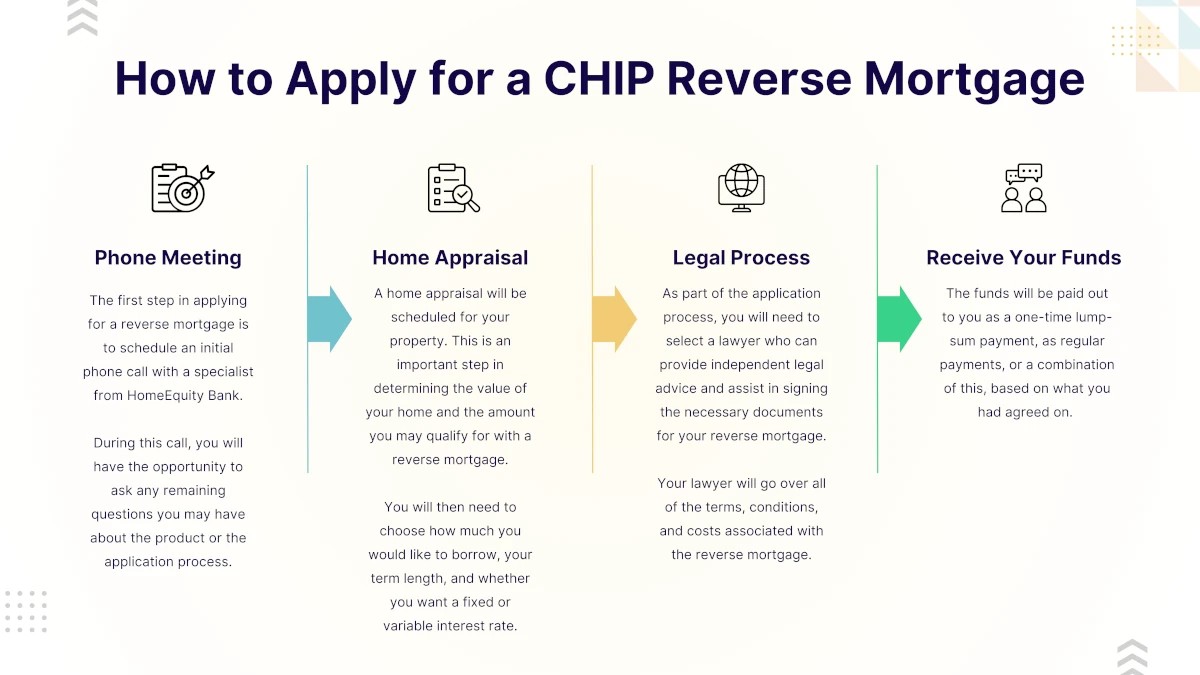
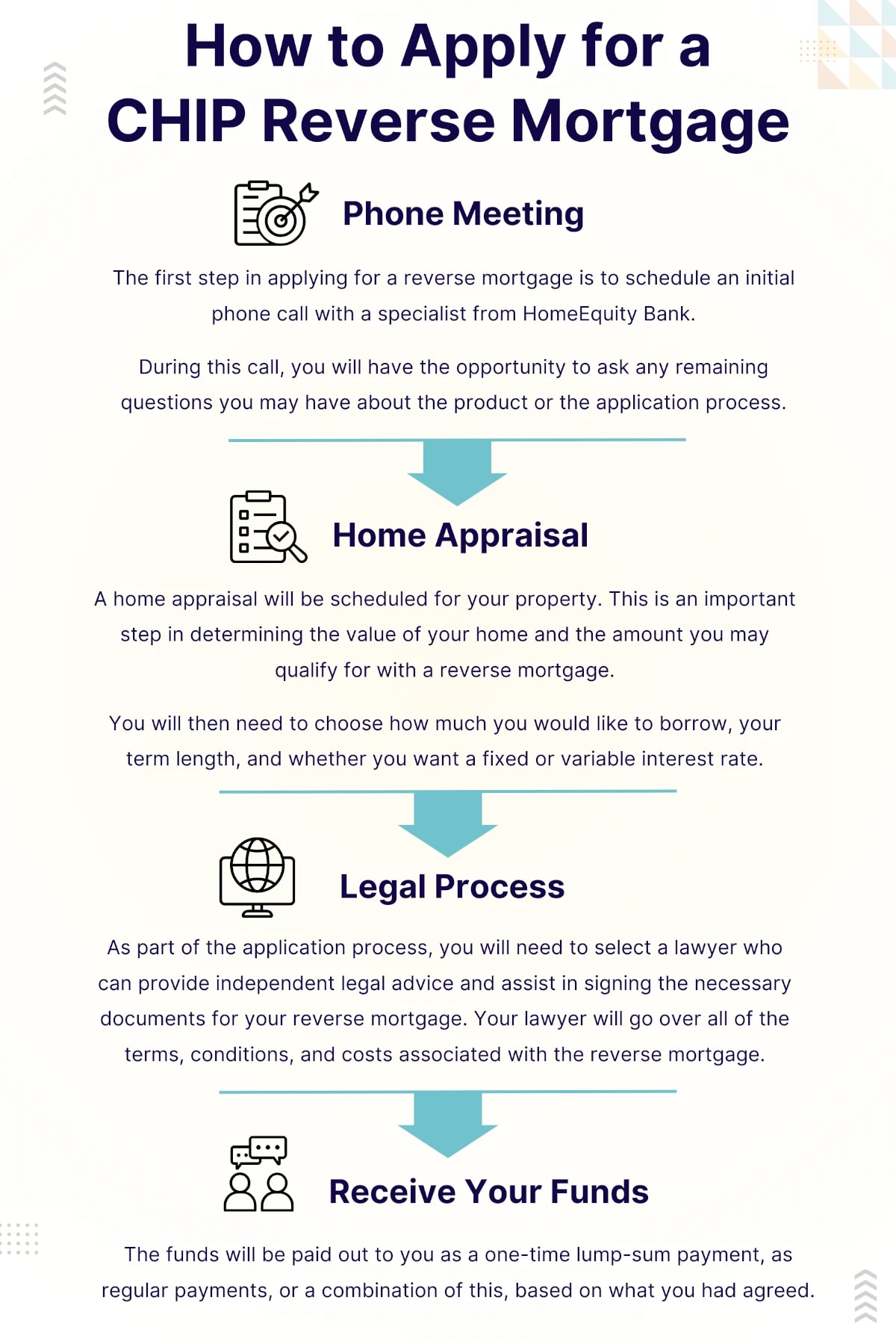
How to Apply for a CHIP Reverse Mortgage
Applying for a CHIP Reverse Mortgage is a step-by-step process. You do not need to make a decision right away, and you will have time to ask questions, review the costs, and speak with a lawyer before signing.
1. Estimate how much you may be able to borrow
Start by using a CHIP Reverse Mortgage calculator or speaking with a reverse mortgage specialist. The amount you may qualify for depends on your age, your home's appraised value, your property location, and any existing mortgage or secured debt on the home. The youngest homeowner's age is important — if you own the home with a spouse or another person, all owners usually need to be at least 55 years old.
2. Speak with a reverse mortgage specialist
The next step is usually a phone meeting with a HomeEquity Bank representative or a mortgage professional. During this call, you can ask questions about the different CHIP products, including CHIP Reverse Mortgage, CHIP Max, CHIP Open, and Income Advantage. This is also when you can discuss how you want to receive the money.
3. Complete the application
If you decide to move forward, you will complete an application. You need to provide information about your home, your current mortgage balance, your property taxes, and your preferred borrowing amount. If you already have a mortgage, line of credit, or other debt secured against your home, it will need to be paid off using the reverse mortgage funds.
4. Get a home appraisal
A home appraisal is required to confirm the value of your property. After the appraisal, you will be able to review the amount available to you, the interest rate, the APR, the fees, and the product terms.
5. Choose your CHIP product and rate type
Before closing, you will choose the CHIP product that best fits your needs. You may also need to choose between a fixed or variable rate, depending on the product.
6. Get independent legal advice
Before the reverse mortgage is finalized, you must speak with a lawyer. The lawyer will explain the agreement, review the costs and conditions, and make sure you understand your responsibilities, including when the loan must be repaid, how interest is charged, and what happens if you sell your home, move out permanently, or pass away.
7. Receive your funds
Once the paperwork is complete, the funds are advanced to you. Depending on the product you choose, you may receive the money as:
| Payment Option | How It Works |
|---|---|
| Lump sum | You receive the money all at once. |
| Regular advances | You receive scheduled monthly or quarterly payments. |
| Combination | You receive some money upfront and the rest over time. |


CHIP Reverse Mortgage Cash Rebate Offers
Some borrowers may qualify for a cash rebate when they get a CHIP Reverse Mortgage through HomeEquity Bank. These offers are available through partner organizations, such as CARP (Canadian Association of Retired Persons) or The Royal Canadian Legion. Rebate offers can change, so always confirm the latest details before applying.
CARP member rebate
CARP members may be eligible for a cash rebate after their CHIP Reverse Mortgage is funded.
| Offer | Details |
|---|---|
| Rebate amount | Up to $250 |
| Who may qualify | CARP members |
| Timing | Usually paid within 90 days after the reverse mortgage is funded |
| Important note | The rebate amount is the lesser of the home appraisal cost or $250 |
Royal Canadian Legion member rebate
Members of The Royal Canadian Legion are also eligible for a cash rebate after funding a CHIP Reverse Mortgage.
| Offer | Details |
|---|---|
| Rebate amount | Up to $500 |
| Who may qualify | Eligible Legion members |
| Important note | Paid by electronic funds transfer (EFT) to your bank account 90 days after the CHIP reverse mortgage is funded |
Is a CHIP Reverse Mortgage Taxable?
No. Money from a reverse mortgage is generally not taxable because it is borrowed money, not income. This means a CHIP Reverse Mortgage does not directly reduce Old Age Security, Guaranteed Income Supplement, CPP, or other income-tested benefits because the funds are not counted as taxable income. However, how you use or invest the money may have tax or benefit implications. Speak with a tax professional or financial planner if you are unsure.
What Can You Use a CHIP Reverse Mortgage For?
| Use | Example |
|---|---|
| Paying off debt | Credit cards, lines of credit, personal loans, or an existing mortgage |
| Renovations | Accessibility upgrades, bathroom renovations, roof repairs |
| Retirement income | Covering monthly expenses or supplementing pension income |
| Health and home care | In-home care, mobility equipment, medical expenses |
| Helping family | Helping children with a down payment, education, or emergency costs |
| Lifestyle | Travel, hobbies, or enjoying retirement |
| Bridge financing | Short-term cash needs before selling or moving |
CHIP Reverse Mortgage vs HELOC, Refinancing, and Personal Loans
A reverse mortgage is not the only way to access home equity. Seniors may also consider a HELOC, mortgage refinance, home equity loan, or personal loan.
| Feature | CHIP Reverse Mortgage | HELOC | Mortgage Refinancing | Home Equity Loan |
|---|---|---|---|---|
| Monthly payments required? | No | Usually interest-only payments | Yes | Yes |
| Income qualification? | Limited compared with traditional lending | Yes | Yes | Yes |
| Secured by home? | Yes | Yes | Yes | Yes |
| Typical loan amount | Up to 55% of your home's appraised value, less any existing mortgage or secured debt | Up to 65% of your home's appraised value | Usually up to 80% of your home's appraised value, less your current mortgage balance | Usually up to 80% of your home's appraised value, less your current mortgage balance |
| Best for | Seniors who want home equity access without monthly payments | Borrowers with strong income and credit who want flexible borrowing | Borrowers who can qualify and want to access equity at a lower rate | Borrowers who want to borrow a lump sum amount |
Other Borrowing Options to Consider
Home Equity Line of Credit (HELOC)
A HELOC is a revolving line of credit secured by your home. You can borrow money as needed, repay it, and borrow again up to your approved credit limit.
Key features:
- Usually requires good credit and sufficient income
- Secured by your home
- Often has interest-only minimum payments
- Best for ongoing or flexible borrowing needs
Best for: Homeowners who want flexibility and can comfortably make payments.
Learn About HELOCsMortgage Refinancing
Mortgage refinancing means replacing your current mortgage with a new, larger mortgage and taking the difference in cash.
Key features:
- Usually requires good credit, stable income, and home equity
- Secured by your home
- Requires regular monthly mortgage payments
- Can allow borrowing up to 80% of your home's value
Best for: Homeowners who qualify for a traditional mortgage and want to access equity at a lower rate.
Learn About Mortgage RefinancingSecond Mortgage
A second mortgage is a separate loan secured against your home, in addition to your existing mortgage.
Key features:
- Secured by your home
- Usually provides a lump sum
- Requires regular payments
- Can be useful when refinancing is not the right fit
Best for: Homeowners who need a lump sum and want an alternative to refinancing.
Learn About Second MortgagesPersonal Loan
A personal loan is unsecured, which means your home is not used as collateral.
Key features:
- Not secured by your home
- Requires good credit and income
- Requires fixed regular payments
- Good for smaller borrowing needs
Best for: Borrowers who need a smaller amount and do not want to borrow against their home.
Learn About Personal LoansWhich Option Is Best?
A CHIP Reverse Mortgage may be the best fit if you are age 55 or older, have significant home equity, and want to avoid monthly mortgage payments. A HELOC, mortgage refinance, or second mortgage may cost less, but these options usually require stronger income and regular monthly payments. A personal loan may be useful for smaller borrowing needs, but it typically offers a lower borrowing amount and a higher interest rate than home-secured options.
CHIP Reverse Mortgage vs Other Reverse Mortgage Lenders
HomeEquity Bank is one of the main reverse mortgage lenders in Canada, but it is not the only option. Other reverse mortgage lenders are Equitable Bank, Bloom, and Home Trust.
| Lender | Product | Borrowing Limit | Availability | Notes |
|---|---|---|---|---|
| HomeEquity Bank | CHIP Reverse Mortgage, CHIP Max, CHIP Open, Income Advantage | Up to 55% of home value | Broad availability across Canada | Most established reverse mortgage brand in Canada |
| Equitable Bank | Flex, Flex PLUS, Flex Lite | Up to 55% of home value (or 59% with Flex PLUS) | Alberta, British Columbia, Ontario, and Quebec | Offers a best rate match feature on comparable posted reverse mortgage rates |
| Bloom | Reverse Mortgage | Up to 55% of home value | Ontario, Alberta, and British Columbia | Offers competitive rates |
| Home Trust | EquityAccess, EquityAccess+, EquityAccess Boost | Up to 60% of home value | Ontario, Nova Scotia, Alberta, and British Columbia | Available only through mortgage brokers |
When comparing lenders, look at more than the rate. Compare:
- How much you can borrow
- The APR
- Setup and closing fees
- Legal and appraisal costs
- Prepayment rules
- Product availability in your province or city
- Whether advances can be scheduled
- Whether the product includes a no negative equity guarantee
Reverse Mortgage Market in Canada
Canada's reverse mortgage market is still small compared with the overall mortgage market, but it has grown significantly over the past decade as more older homeowners look for ways to access home equity during retirement. This growth is partly because many seniors own valuable homes but have limited monthly income, while Canada's population is aging.
What OSFI data shows
OSFI, Canada's federal banking regulator, collects financial data from banks and other federally regulated lenders. As of March 31, 2026, OSFI data shows about $10.89 billion in Canadian-dollar reverse mortgage balances across reporting lenders. HomeEquity Bank, which offers CHIP Reverse Mortgage, remains the largest reverse mortgage lender in Canada, with about $8.25 billion in reverse mortgage balances. This was up from about $7.2 billion as of March 31, 2025. Five years ago, it was only $3.8 billion. That means HomeEquity Bank's reverse mortgage portfolio grew by about 15% over the past year and has more than doubled in just five years.
| Lender / Institution | Latest Available Reporting Period | Reverse Mortgage Portfolio Size | Estimated Market Share |
|---|---|---|---|
| HomeEquity Bank (CHIP) | March 31, 2026 | $8.25 billion | 74% |
| Equitable Bank | March 31, 2026 | $2.55 billion | 23% |
| Home Trust (Fairstone Bank) | March 31, 2026 | $12 million | Less than 1% |
Note: Small balances held at other institutions are not included above.
The main takeaway is simple: CHIP is the largest and most established reverse mortgage brand in Canada, but competitors are growing quickly, highlighting just how popular reverse mortgages are getting in Canada.
Is a CHIP Reverse Mortgage Safe?
CHIP Reverse Mortgage is offered by HomeEquity Bank, a federally regulated bank. With over 40 years of experience providing reverse mortgages to Canadians, HomeEquity Bank and CHIP have a track record of helping thousands of homeowners achieve financial stability during retirement.
CHIP reverse mortgages also include a No Negative Equity Guarantee. This means that if you meet your mortgage obligations, you will not owe any more money when your home is sold. However, “safe” does not mean “free” or “risk-free.” The main risk is that interest compounds over time, which reduces the equity left in your home.
When Does a CHIP Reverse Mortgage Make Sense?
A CHIP Reverse Mortgage may make sense if:
- You are 55 or older.
- You want to stay in your home.
- You have significant home equity.
- You do not want monthly mortgage payments.
- You need money for debt, home repairs, care costs, or retirement expenses.
- You understand that the loan balance will grow over time.
It may not make sense if:
- You plan to sell very soon and do not need short-term financing.
- You can qualify for a lower-cost HELOC or refinance and can afford the payments.
- You want to preserve as much home equity as possible for your estate.
- You only need a small amount of money.
- You are not comfortable with interest accumulating over time.
Questions to Ask Before Getting a CHIP Reverse Mortgage
- How much do I actually need?
- Do I need a lump sum or scheduled advances?
- How long do I expect to stay in my home?
- Would CHIP Open be better if I plan to repay soon?
- How much equity might be left after 5, 10, or 15 years?
- What are the total fees?
- What happens if I move into long-term care?
- What happens when I pass away?
- How will this affect my estate plan?
- Have I compared other lenders?
Frequently Asked Questions
What is a CHIP Reverse Mortgage?
A CHIP Reverse Mortgage is a loan secured by your home. It allows Canadian homeowners aged 55 and older to access part of their home equity without selling their home or making monthly mortgage payments.
How much can I borrow with CHIP?
You may be able to borrow up to 55% of your home's appraised value. Your actual amount depends on your age, home value, location, property type, existing mortgage balance, and lender approval.
Do I still own my home?
Yes. You keep ownership of your home. You must continue to pay property taxes, keep home insurance, maintain the property, and follow your mortgage agreement.
Do I need to make monthly payments?
No regular monthly mortgage payments are required. Interest is added to the loan balance over time.
Is CHIP Reverse Mortgage money taxable?
No. Reverse mortgage funds are borrowed money, not income, so they are generally not taxable.
Does a CHIP Reverse Mortgage affect OAS or GIS?
The money from a reverse mortgage is not taxable income, so it should not directly affect OAS or GIS. However, if you invest the money and earn income, that investment income may affect benefits.
What is the difference between CHIP, CHIP Max, CHIP Open, and Income Advantage?
The standard CHIP Reverse Mortgage is the main lump-sum product. CHIP Max is designed for borrowers who want access to more equity upfront. CHIP Open is for short-term borrowing and can be repaid without a prepayment charge. Income Advantage provides an initial advance plus monthly or quarterly scheduled advances.
What fees does CHIP charge?
Fees range from $1,795 to $2,995 or more, depending on the product and the amount that you are borrowing. Common costs include a home appraisal, independent legal advice, a closing fee, and administrative fees. CHIP Open has a higher closing fee than the standard CHIP Reverse Mortgage.
Can I repay a CHIP Reverse Mortgage early?
Yes, but prepayment rules depend on the product. CHIP Open allows repayment at any time without a prepayment charge. Other CHIP products have specific prepayment privileges, such as one annual payment of up to 10% of the principal and interest amount.
What happens if I already have a mortgage?
You may still qualify, but your existing mortgage will need to be paid off using the reverse mortgage proceeds.
What happens when I sell my home?
The reverse mortgage is repaid from the sale proceeds. Any remaining equity belongs to you.
What happens when the borrower dies?
The loan becomes due after the last borrower passes away. The estate usually repays the loan from the sale of the home or other funds.
Can I lose my home with a CHIP Reverse Mortgage?
You continue to own your home, but you must meet your obligations. This includes paying property taxes, keeping home insurance, maintaining the property, and following the mortgage agreement.
Is CHIP better than a HELOC?
It depends. A HELOC may have a lower rate, but it usually requires income qualification and monthly payments. CHIP may be easier for seniors who have home equity but limited income and do not want monthly payments.
Is CHIP Open worth it?
CHIP Open may be worth it if you expect to repay the loan soon. It has a higher rate and closing fee, but it allows repayment without a prepayment charge.
Is Income Advantage better than taking a lump sum?
Income Advantage may be better if you want regular cash flow and do not need all the money immediately. Taking funds gradually reduces how quickly interest accumulates compared with taking the full amount upfront.
Disclaimer:
- Any analysis or commentary reflects the opinions of WOWA.ca analysts and should not be considered financial advice. Please consult a licensed professional before making any decisions.
- The calculators and content on this page are for general information only. WOWA® does not guarantee the accuracy and is not responsible for any consequences of using the calculator.
- Financial institutions and brokerages may compensate us for connecting customers to them through payments for advertisements, clicks, and leads.
- Interest rates are sourced from financial institutions' websites or provided to us directly. Real estate data is sourced from the Canadian Real Estate Association (CREA) and regional boards' websites and documents.