






Home Renovation Loans in Canada


What You Should Know
- Home renovation loan options include using your home equity, getting a second mortgage, personal loans, credit cards, and store financing programs
- Borrowing money to renovate your home can increase your home’s value, improve your quality of life, and save money through energy-efficient upgrades
- Not all home renovation loan options are the same - they differ in the amount you can borrow, interest rates, and the time frame that they are suitable for
What Are Home Renovation Loans?


Whether you want to add a few skylights, install a fireplace, remodel your kitchen, build an addition, or replace your roof, a renovation project can be expensive. If you do not have enough savings to pay for the full project upfront, a home renovation loan can help you finance the cost over time.
A home renovation loan is any type of loan or credit product used to pay for home repairs, upgrades, or improvements. In Canada, common home renovation financing options include:
- Home equity line of credit (HELOC)
- Home equity loan or second mortgage
- Mortgage refinance
- Personal loans
- Personal lines of credit
- Credit cards
- Store financing or retailer project loans
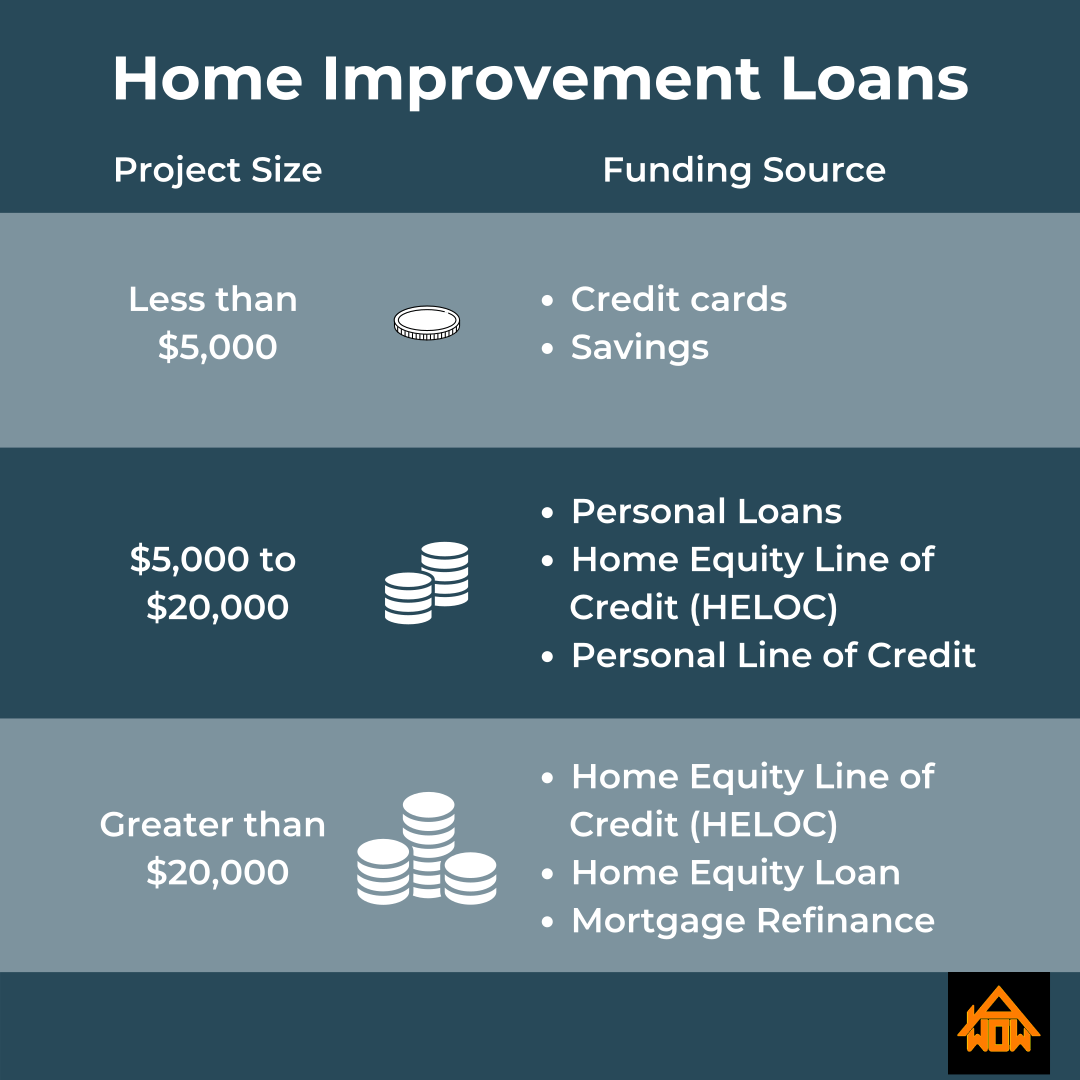
These options all allow you to borrow money for home improvements, but they work differently. Some are secured against your home, such as a HELOC, home equity loan / second mortgage, or mortgage refinance. These options usually have lower interest rates, but they may require home equity, income verification, an appraisal, and more time to arrange.
Other options, such as personal loans, personal lines of credit, credit cards, and store financing, may be easier or faster to access. However, they often have higher interest rates, lower borrowing limits, or restrictions on where the funds can be used.
The best way to finance a home renovation depends on your project size, timeline, available home equity, credit score, income, and ability to repay the debt. You may also use more than one financing option. For example, you might use a credit card for small upfront purchases while waiting for a HELOC application to be approved.
The main things to compare when choosing a home renovation financing option are:
- Cost of borrowing
- How much you can borrow
- How easy it is to qualify
- How quickly you can access the funds
- Whether the loan is secured against your home
- Whether the funds can be used for all renovation costs or only specific purchases
Types of Home Improvement Loans

Home Renovation Loans by Interest Rate
| Funding Source | Typical Interest Rate |
|---|---|
| Mortgage Refinance | 3.85% - 6.85% |
| Home Equity Line of Credit (HELOC) | 4.95% - 5.95% |
| Second Mortgage / Home Equity Loan | 7% to 15%+ |
| Personal Line of Credit | 7.45% to 15%+ |
| Personal Loan | 8% to 20%+ |
| Store Financing | 0% promotional to 30%+ |
| Credit Cards | 19.99% to 30%+ |
Typical rates vary by lender, borrower profile, and market conditions. Secured options such as mortgage refinancing and HELOCs usually have lower rates than unsecured personal loans, store financing, and credit cards.
Home Equity Loan / Second Mortgage
A home equity loan is a fixed amount of money that you borrow using your home equity as collateral. In Canada, this type of loan is often structured as a second mortgage, meaning it is registered against your home in addition to your existing mortgage.
Unlike a HELOC, which lets you borrow from a revolving credit limit as needed, a home equity loan or second mortgage usually provides a lump sum upfront. You then repay the loan through regular payments over a set period. This can make it useful for larger renovation projects that require a significant upfront payment, such as a kitchen remodel, home addition, or roof replacement.
Because the loan is secured by your home, a home equity loan may let you borrow more than an unsecured personal loan and may offer a lower interest rate. However, the rate is usually higher than the rate on your first mortgage because the second mortgage lender is second in line to be repaid if you default.
To qualify, you need enough home equity. In most cases, your total mortgage debt, including your first mortgage and home equity loan or second mortgage, cannot exceed 80% of your home’s value. This means you generally need to have more than 20% home equity before you can borrow this way.
A home equity loan or second mortgage can be a good option for homeowners who need a lump sum for a major renovation, but it also adds another debt payment and uses your home as security. If you miss payments, the lender may take legal action, including enforcing its security against your home.
Home Equity Line of Credit (HELOC)
A home equity line of credit, or HELOC, lets you borrow money using your home equity as collateral. It is similar to a home equity loan or second mortgage because it is secured by your home, but it works differently. Instead of receiving one fixed lump sum, you are approved for a revolving credit limit that you can borrow from as needed.
This makes a HELOC useful for renovation projects with costs spread out over time. For example, if you are renovating your kitchen, you may need to pay for materials, contractors, appliances, and finishing work at different stages. With a HELOC, you can borrow only when you need the money, and you only pay interest on the amount you actually use.
HELOCs usually have lower interest rates than unsecured personal loans and credit cards, but the rate is often variable. This means your interest cost and monthly payment can rise if interest rates increase.
To qualify for a HELOC, you need enough home equity. A HELOC itself can be up to 65% of your home’s value. However, if you also have a mortgage, your mortgage balance plus your HELOC limit cannot exceed 80% of your home’s value.
For example, if your home is worth $500,000, the maximum combined mortgage and HELOC debt would be $400,000, which is 80% of the home’s value. If your current mortgage balance is $300,000, you may be able to qualify for a HELOC of up to $100,000, assuming you meet the lender’s income, credit, and other requirements.
If you want a standalone HELOC with no mortgage attached, you generally need to have more home equity. In that case, the HELOC limit is usually capped at 65% of the home’s value, meaning you would need at least 35% equity.
Some lenders provide access cards or online banking access for HELOCs, making it easy to pay for renovation purchases directly from your line of credit. This can make a HELOC almost as convenient as a credit card, but with a lower interest rate and often a higher credit limit.
The minimum monthly payment on a HELOC may also be lower than on a credit card because some HELOCs allow interest-only payments. However, interest-only payments do not reduce the amount you owe. If you only pay the interest each month, your renovation debt can remain outstanding for a long time.
Mortgage Refinance
A cash-out mortgage refinance involves you replacing your current mortgage with a new mortgage that has a higher mortgage balance. The difference between your new and old mortgage balance is the amount that you are borrowing. You will be able to use this amount to pay for your home renovations.
Depending on when you refinance your mortgage, you may or may not be charged penalties or fees. If you refinance during your term, your mortgage lender will charge mortgage prepayment penalties for breaking your mortgage. You can avoid break penalties if you refinance at the end of your mortgage term when it is up for renewal. If you refinance with another lender, you will also be charged a discharge fee by your current lender.
A refinance lets you borrow at low mortgage refinance rates, though you will also be limited to a maximum refinanced mortgage of 80% of your home’s value. However, for larger projects or building a new home you may consider a home construction loan.
Personal Loans
Personal loans have an easier and quicker application process compared to refinancing your mortgage or getting a HELOC. This is best for those who need to pay renovation expenses relatively soon, but don't have enough equity in their home to get a secured loan. Depending on the lender, you may have to provide the plan for the construction to get a lower interest rate. You may have to calculate all your expenses, such as calculating how much paint you need, to have a clear construction plan and budget.
Personal loans can be secured or unsecured. Unsecured loans will have higher interest rates and shorter payback periods, such as below 60 months. The rate can also be significantly higher depending on your financial situation, such as if you have a poor credit score or low income.


Credit Cards
Borrowing from a credit card isn't ideal if you aren't able to pay it back quickly, with credit cards having very high interest rates. If your home improvement project is small, such as it costing only a few thousand dollars, a credit card might be an option for you to easily finance your project for a short period of time. If you can’t pay it back soon and will need to pay your loan off over a longer period of time, using a credit card to finance home renovations wouldn’t be such a good idea. However, credit cards have a 21-day grace period meaning there is no interest for a few weeks. Some people will use their cash back credit card to finance renovations while they wait for their next paycheck.
Store Financing Programs
Many home improvement stores in Canada offer store credit cards and financing programs to help customers pay for their projects over time. These options often come with added perks, such as longer return windows, extended warranties, and special promotional offers. If you’re taking on a smaller DIY project and want a quick, convenient way to finance it, a store credit card or in-store financing plan can be easy to arrange.
The largest home improvement retailer in Canada is Home Depot, followed by RONA. Both, along with other national chains, offer credit services and financing programs to their customers. In most cases, you don’t need to be a professional or commercial contractor to qualify.
Most store financing programs are administered by third-party lenders rather than the retailers themselves. For example, BMR Group, a hardware chain in eastern Canada, offers financing through Fairstone Financial, Castle Building Centres partners with Flexiti for instant financing, and Timber Mart also works with Fairstone Financial.
At many retailers, you can also spread purchases over time using buy now, pay later (BNPL) plans through providers such as Affirm, which was formerly known as PayBright in Canada.
Home Depot
Home Depot Canada offers several financing options for renovation purchases, including a consumer credit card, a Project Loan Card, and commercial credit accounts. The consumer credit card and Project Loan Card are available to individual customers, while Home Depot’s commercial revolving card and commercial account are designed for contractors, businesses, and other commercial customers.
The commercial revolving card works like a credit card, allowing cardholders to carry a balance, while the commercial account works more like a charge card, requiring the balance to be paid in full each month. Home Depot Pro Xtra members can also earn an extra 1% in Quarterly Rewards when they link an eligible Home Depot commercial credit card to their Pro Xtra account.
Home Depot Consumer Credit CardInterest Rate: 28.80%Annual Fee: $0Return Period: Up to 365 daysPromotional Offers: No-interest financing offers may be available on eligible purchases
Home Depot works with Citi Cards Canada to offer the Home Depot Consumer Credit Card. Customers can apply online or in-store, and the card can be used for purchases at Home Depot Canada stores and online at homedepot.ca.
One of the main benefits of the Home Depot Consumer Credit Card is the extended return period. Cardholders may receive up to 365 days to return eligible purchases, compared with the standard 90-day return period offered for many purchases made with other payment methods.
The card may also offer promotional financing, such as no-interest offers on eligible purchases if the balance is paid in full within the promotional period. These offers can be useful for short-term renovation financing, but only if the balance is paid off before the promotion ends. If the balance is not paid in full by the deadline, interest may apply according to the card’s terms.
The Home Depot Consumer Credit Card has no annual fee, but its regular interest rate is high. This makes it a poor choice for carrying a balance over a long period. For larger renovation projects, a HELOC, personal loan, mortgage refinance, or Home Depot Project Loan may offer a lower borrowing cost.
Another important detail is that items purchased with the Home Depot Consumer Credit Card may be used as security for the card balance. This means that if you do not make your required payments, Home Depot may have the right to repossess items purchased with the card.
Example: Home Depot Consumer Credit CardSuppose you make $10,000 of renovation purchases using the Home Depot Consumer Credit Card and carry the full balance for one year at an annual interest rate of 28.80%.
Borrowing Amount: $10,000Interest Rate: 28.80%Term: 1 year
If the balance stayed at $10,000 for the full year, the interest cost would be approximately $2,880. This example assumes that the balance is not reduced during the year. In practice, your actual interest cost would depend on your payments, billing cycle, grace period, and whether a promotional financing offer applies.
The card may have a grace period on new purchases, which means that no interest is charged if the full balance is paid by the due date and there is no previous unpaid balance. However, once you carry a balance, interest can add up quickly.
Home Depot Project LoanInterest rate: 0% APR during the 3-month shopping period, then 7.99% to 15.99% APRRepayment term: Up to 60 months for balances over $1,000Fees: No annual fee and no prepayment penaltyCredit limit: Up to $55,000Use: Home Depot purchases only
The Home Depot Project Loan Card is built for larger renovation projects, offering up to $55,000 in credit through its financing partner, FinanceIt Canada. Unlike the Home Depot Consumer Credit Card, it gives you a set shopping period to make eligible project purchases, which you can do in-store, online at homedepot.ca, and for select Home Depot Home Services.
Minimum monthly payments are still required during the shopping period, even though the APR is 0%. Once the period ends, your outstanding balance converts into a fixed-payment loan: balances over $1,000 are repaid over 60 equal monthly payments, while balances of $999.99 or less are generally repaid over 12 months.
At that point, the fixed APR falls between 7.99% and 15.99%, depending on credit approval and other factors. That’s usually well below the regular rate on the Home Depot Consumer Credit Card, which makes the Project Loan the stronger choice for larger purchases you plan to pay off over several years.
The trade-off is that the Project Loan can only be used at Home Depot. It can’t pay contractors directly, cover supplies from other retailers, or fund expenses outside Home Depot. If your budget includes labour, permits, design fees, or purchases from multiple stores, you’ll likely need another financing option alongside or instead of it.
There’s no prepayment penalty, so you can pay the loan off early and cut down your total interest whenever you’re able to make extra payments.
Example: Home Depot Project LoanSuppose you borrow $10,000 through the Home Depot Project Loan and repay it over 60 months after the 3-month shopping period. Your actual payment depends on the APR you qualify for.
Borrowing Amount: $10,000Term: 60 monthsAPR Range: 7.99% to 15.99%
At 7.99%, the monthly payment would be about $203, and the total interest over 60 months would be about $2,163.
At 15.99%, the monthly payment would be about $243, and the total interest over 60 months would be about $4,588.
This means a $10,000 Home Depot Project Loan could cost roughly $2,163 to $4,588 in interest over five years, depending on the rate you qualify for. Paying the loan off early would reduce the total interest paid.
Home Depot Credit Card vs. Project LoanThe Home Depot Consumer Credit Card may be useful for smaller purchases, short-term promotional financing, or customers who want the extended return period. However, it has a high regular interest rate, making it expensive if you carry a balance.
The Home Depot Project Loan is better suited for larger renovation purchases from Home Depot that you want to repay over time. It offers a short 0% shopping period followed by fixed monthly payments, usually at a lower rate than the store credit card.
For renovations that involve multiple suppliers, contractor labour, or high costs beyond Home Depot purchases, compare the Project Loan with other options such as a HELOC, mortgage refinance, personal loan, or personal line of credit.
RONA



RONA offers financing through third-party providers, including Flexiti and Affirm. Flexiti is generally used for eligible in-store financing at participating RONA and RONA+ locations, while Affirm may be available for eligible online purchases at rona.ca.
These financing options can help customers split the cost of renovation materials, appliances, tools, fixtures, and other eligible purchases. However, financing availability depends on the purchase amount, store participation, province, credit approval, and the specific terms offered at checkout.
RONA Flexiti FinancingFlexiti is RONA’s primary financing provider for eligible in-store purchases. Customers who are approved can use Flexiti financing at participating RONA and RONA+ locations.
RONA’s Flexiti financing plans may include promotional equal monthly payment plans, Buy Now, Pay Later plans, and longer-term financing offers. Available terms, interest rates, and promotional periods can change and may depend on purchase amount, credit approval, province, and participating store.
A minimum purchase of $300 before taxes is generally required for RONA’s Flexiti promotional plans.
With an equal monthly payment plan, the purchase is split into fixed monthly payments. Some promotional plans may offer 0% interest if all required payments are made on time and the terms of the promotion are followed.
With a Buy Now, Pay Later plan, payment can be deferred for a set period. However, the balance must be paid according to the plan’s terms. If the promotion expires, is cancelled, or required payments are missed, interest may apply at the account’s regular annual interest rate.
RONA’s financing terms show that the regular Account AIR can be much higher than the promotional rate. This means Flexiti financing is most useful when you are confident that you can make the required payments and repay the balance within the promotional period.
RONA Affirm FinancingAffirm is available for eligible online purchases at rona.ca. Instead of using a store card, approved customers can choose Affirm at checkout and split an eligible purchase into biweekly or monthly payments.
RONA’s Affirm option may include:
- 4 biweekly interest-free payments
- Monthly payment plans for eligible purchases of $100 or more
- Financing terms are shown at checkout before the customer agrees
Affirm can be useful for online RONA purchases because the repayment terms are shown upfront before checkout is completed. Affirm also says it does not charge late fees or hidden fees. However, approval is not guaranteed, and the available payment terms may depend on the customer, purchase amount, and checkout offer. Your APR will be 0 – 31.99%.
Flexiti vs. Affirm at RONAFlexiti and Affirm are separate financing providers. Flexiti is mainly for eligible in-store purchases at participating RONA and RONA+ locations, while Affirm is mainly for eligible online purchases through rona.ca.
| RONA Financing Option | Best For | How It Works |
|---|---|---|
| Flexiti | In-store purchases | Promotional financing plans, including equal monthly payments and Buy Now, Pay Later offers |
| Affirm | Online purchases | Biweekly or monthly installment payments at checkout |
Both options can make renovation purchases easier to manage, but they are not the same as a general-purpose renovation loan. They are usually limited to eligible RONA purchases and may not cover contractor labour, permit fees, design services, or materials bought from other retailers.
Example of RONA FinancingSuppose you make a $3,000 renovation purchase at RONA and choose a 36-month Flexiti equal monthly payment plan at 4.99% interest.
Borrowing Amount: $3,000Interest Rate: 4.99%Term: 36 months
The monthly payment would be about $90, and the total interest cost over the 36-month term would be about $236.
If you instead qualify for a 12-month 0% promotional plan on the same $3,000 purchase, the monthly payment would be $250, and the total interest cost would be $0, assuming all required payments are made on time and the promotional terms are followed.
This shows the trade-off between shorter 0% financing and longer repayment terms. A 0% plan can reduce borrowing costs, but it requires higher monthly payments. A longer plan may have lower monthly payments, but it can cost more in interest.
When RONA Financing Makes SenseRONA financing may make sense if you are buying eligible products from RONA and can repay the balance within the promotional period. It can be useful for purchases such as appliances, flooring, tools, lighting, fixtures, paint, and renovation materials.
However, RONA financing may not be the best choice for a full renovation project if your costs include contractor labour, permits, design fees, or purchases from multiple suppliers. For larger renovations, compare RONA financing with other options such as a HELOC, personal loan, personal line of credit, second mortgage, or mortgage refinance.

Should I Get a Home Renovation Loan?
There are benefits to renovating your home besides just adding value to your home. A home renovation can improve your quality of life and may address necessary repairs and upgrades. This can mean making your home more energy efficient and saving you money by lowering your energy and water bills or even making your home more comfortable or safer. You could qualify for home renovation tax credits for these upgrades. The icing on top of this is that home renovations often add value to your home, which may result in a higher home selling price compared to the cost of the renovations. A newly renovated home may also make your home more attractive to buyers.
If you can afford the costs of renovating your home, which can include the monthly payments towards any home renovation loan, then it might be a good idea to renovate your home if you have a particular goal in mind. Renovation loans allow you to borrow money to finance your renovations, which means that you don’t need to come up with all of this money upfront. Some types of financing, such as store credit cards, have special offers that allow you to pay zero interest for a select number of months. This can be used as temporary financing while you get more longer-term financing in place. Even regular credit cards have a grace period that has no interest if you pay it off in full.
However, the money borrowed from a renovation loan will still need to be paid back eventually. HELOCs and second mortgages give you access to a large amount of money, which can tempt you to overspend and go over your budget. Having a set budget ahead of time is important to make sure that you don’t spend more than you can afford. Since renovation loans are loans, not free money, it might not be a good idea to renovate your home now if you can’t comfortably afford any additional loan payments in the first place.
Before choosing a home renovation financing option, gather the information you need to compare your choices. This can help you estimate how much you can borrow, what your payments may be, and whether a secured or unsecured loan makes more sense.
- Your estimated home value
- Your current mortgage balance
- Your available home equity
- Your credit score
- Your monthly income and debt payments
- Your contractor’s quote or renovation budget
- Whether permits are required
- Whether the renovation is urgent
- Whether you can afford the payments if interest rates rise
Disclaimer:
- Any analysis or commentary reflects the opinions of WOWA.ca analysts and should not be considered financial advice. Please consult a licensed professional before making any decisions.
- The calculators and content on this page are for general information only. WOWA® does not guarantee the accuracy and is not responsible for any consequences of using the calculator.
- Financial institutions and brokerages may compensate us for connecting customers to them through payments for advertisements, clicks, and leads.
- Interest rates are sourced from financial institutions' websites or provided to us directly. Real estate data is sourced from the Canadian Real Estate Association (CREA) and regional boards' websites and documents.