

Joint Mortgage in Canada: All You Need to Know


What You Should Know
- A joint mortgage allows multiple borrowers to apply for one mortgage, and all borrowers are fully responsible for the entire mortgage, not just their share.
- Each borrower's income, debt, and credit score affect approval and rates. Borrowers can be family, friends or anyone a lender will accept.
- Ownership type (joint tenancy vs tenants in common) determines what happens if one owner dies or wants to sell.
- Removing a person from a mortgage later requires refinancing or lender approval. Adding a borrower also requires lender approval.
A joint mortgage pools together the financial resources of multiple individuals to qualify for a mortgage. With a higher combined income, you'll be able to afford a larger mortgage or can now finally afford to get on the property ladder. Joint mortgages are commonly used by spouses, friends, investors, or anyone looking to get a home together.

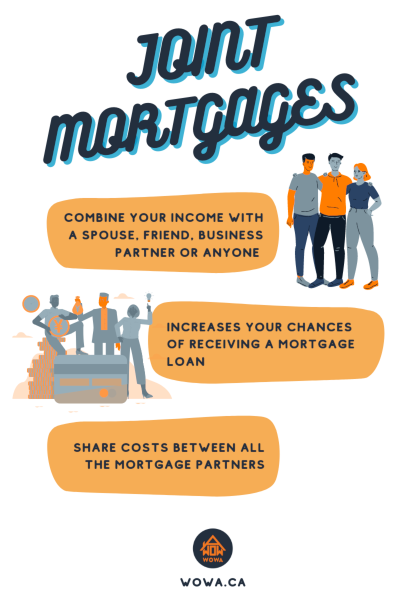
However, you will all be liable for mortgage payments, meaning if someone fails to pay, you will need to make up the difference. There are many other liabilities associated with joint mortgages. It's essential to be aware of worst-case scenarios and how to prevent them. Continue reading to learn all you need to know about joint mortgages in Canada.
| Joint Mortgage | Single Mortgage | |
|---|---|---|
| Likelihood of receiving a mortgage | Increased chances due to higher income | Dependent on your income and credit score |
| Down payment size | Shared by multiple people | Only paid by you |
| Mortgage payments | Shared by multiple people | Only paid by you |
| Mortgage rate | Decreased due to appearing less risky | Dependent on your income and credit score |
| Home ownership | Shared by multiple people | Owned by you |
| Default Risk | Is shared by all borrowers | Is isolated to the only borrower |
Joint Mortgage Explained

A joint mortgage allows multiple people to combine their assets and incomes to qualify for a home loan. A higher combined income can help meet debt service ratio requirements and may improve the interest rate offered. All borrowers are listed on the property title and are fully responsible for the mortgage payments, property taxes, and other ownership costs. Lenders treat every borrower as 100% responsible for the mortgage because it reduces the lender’s risk and ensures that payments continue even if one borrower cannot pay. There are different legal structures for joint ownership, each with distinct implications. The most common types are Joint Tenant and Tenants in Common.
Joint Tenant
Joint tenancy is an ownership structure where all owners own an equal share of the property. It is the most common type of joint mortgage, especially among spouses. Under this arrangement, all parties must agree on major decisions involving the home. For example, the property cannot be sold unless every owner consents.
The credit profile of all borrowers will affect the mortgage decision, so a single mortgage applicant with a bad credit history will negatively affect the whole application. Should your mortgage partner ever default, you will be liable for their missed payments. To prevent this scenario, you can require all joint mortgage participants to have insurance that provides income if they are unable to work due to illness, injury, or other unexpected events. If you can't make the payments yourself, you will also need to declare bankruptcy.
Tenants in Common
This is where each person owns a percentage of the home. It's typically used by friends or investors where one partner has more financial resources. For example, the higher-income friend could cover 60% of homeownership expenses. As a result, they'd own 60% of the home and the appreciation that comes with it. The ownership percentages and fee breakdown can vary to your choosing. However, in this agreement, it's essential to use a real estate lawyer experienced with tenants in common to construct a clear written contract.
If one partner wishes to sell before the other, there are options. After a few years of combined ownership, there should be some appreciation for the house. With this equity, one owner can buy out the other owner. The perfect time to do this is during a mortgage refinance, which typically happens every five years. Otherwise, the buying owner can use a second mortgage. However, there is an additional option if the other partner doesn’t want to sell and is beyond negotiation. A forced sale of the home can happen if one partner goes to court. Since all mortgage partners are listed on the property title, they have the option to sell the house.
However, there has to be sufficient home equity, and the buyer's financial situation must have improved to afford an individual mortgage. As a result, it's wise to include a minimum stay requirement of five to ten years for the tenants in common. Both partners should decide on a method to calculate the purchase price when beginning the tenancy. Additionally, the partner wishing to leave should cover mortgage application costs and any extra fees directly related to their departure. All of this should be written in the contract.
Joint Mortgage Pros and Cons
| Pros | Cons |
|---|---|
|
|
Pros
- Higher chance of qualifying for a mortgage: Mortgage lenders compare your income with the associated costs of owning a home to qualify you for a mortgage. This is known as a debt service ratio which includes expenses such as monthly mortgage payments, property taxes, and utilities. Typically, lenders prefer to see no more than 35% of your income covering these costs. A higher income will increase your chances of qualifying, so long as the associated costs don't increase too much.
- Shared expenses: Buying a home is expensive. On top of down payment requirements, additional costs include land transfer tax, property insurance, inspection fees, and more. These are known as closing costs which cost roughly 3% - 4% of the total home purchase price. These expenses catch many homebuyers off-guard, and having a purchasing partner will help you share costs. After you have purchased the home, you can also share the costs of maintenance and property taxes on top of mortgage payments.
- Receive a larger mortgage: Finally, you'll likely be eligible to qualify for a larger mortgage with a larger income. Given the high home prices in Canada's housing markets, you'll have sufficient funding to close deals quickly.
Cons
- Disagreements: The property is shared, so you'll need to work with your mortgage partners when making decisions about your home. This could mean compromising on a basement renovation or being forced to sell your home early. As mentioned previously, always work with an experienced real estate lawyer who understands the common challenges of joint mortgages. It's encouraged to predict these challenges and have a conversation with your partner. Always have an agreement in writing between you two.
- Increased Liabilities: You are responsible for ensuring the total mortgage gets paid. If your friend loses their job, you may need to pay for their portion of missed payments. If you fail to make the complete mortgage payments, your lender could foreclose your home, which means you will all lose the home. Casualty and disability insurance is also an excellent option to ensure income if anyone can no longer work due to an injury.
- Lack of Privacy: If you are someone who needs privacy, getting a joint mortgage to live with friends could be challenging. Also, keep in mind if any of your friends want to have a partner move in or children within the coming years. Have conversations about everything.
Joint Mortgage Alternatives
Joint mortgages are a solution to help you qualify for a mortgage. However, the four most common alternatives include: co-signing, single mortgages, shared equity mortgages, and house hacking. Each has benefits and drawbacks, so it's essential to understand what each entails before deciding.
| Home Ownership | Property Decision Making | How it Helps | |
|---|---|---|---|
| Co-signer | Only owned by you | Only you | Increases creditworthiness |
| Shared equity mortgages | Shared with a government, builder or private company | Only you | Increases down payment |
| House hacking | Only owned by you | Only you | Increases income |
| Save and wait | N/A | Only you | Time to focus on increasing all of the above |
1. Co-signer
This is where one person is the primary borrower, and the other is a co-signer. The co-signer is not an owner of the property, but they are liable for the mortgage payments. If the primary borrower fails to make payments, the co-borrower is responsible. Parents typically use this type of joint mortgage when helping their children buy a home.

Shared equity mortgages help reduce your down payment, but you will still be required to qualify for the mortgage. The benefit is that a larger down payment will reduce your monthly mortgage payments to help you meet debt ratio requirements. Your mortgage payments will take up a smaller percentage of your income. The catch is that you will share equity with a government, builder or private company, such as Ourboro.
The rules for equity split vary from program to program. However, the equity share will typically depend on the percentage of downpayment received. From 2019 to early 2024, the federal government offered a shared equity mortgage program called the First-Time Homebuyer Incentive. The program has been discontinued since April 2024. Multiple other municipal down payment assistance programs are typically also shared equity mortgages.
3. House Hacking
House hacking is where you purchase a multi-unit property and live in one unit while renting out the other units. This can help you save on rent, increase your cash flow, and build equity in a property. The CMHC rules allow you to buy a multi-unit home of up to four units. You can have a minimum down payment of 5% and use up to 50% of the future rental income to qualify for a rental property mortgage.
However, there are a few things to consider. You'll still need to have some savings for the down payment and closing costs. Additionally, you'll need to be comfortable being a landlord. If you can meet this criteria, it's one of Canada's best wealth-building strategies while buying real estate.
4. Save and Wait
If none of the options above appeal to you, your final choice is to continue renting and save for a down payment. However, it could take you many years to afford a home as the property values continue to rise. It makes sense to continue renting instead of buying a home in some cases. We have this explained on our rent vs. buy calculator page.
Co‑Borrower vs Co‑Signer
A co‑borrower shares ownership, appears on the title, and is fully responsible for the mortgage.
A co‑signer does not own the home but guarantees the mortgage. They are only responsible if the primary borrower fails to make payments.
Co‑signers are often used when the main applicant has insufficient income or credit, and the co‑signer’s financial profile helps meet lending requirements.
How to Remove Someone From a Mortgage in Canada
Removing a borrower from a mortgage isn’t as simple as asking your lender to “take their name off.” When you apply for a joint mortgage, all borrowers become jointly and severally liable, meaning each person is responsible for the entire mortgage amount, not just their share. Lenders approved the original loan based on the combined income, credit scores, and financial strength of all applicants, so removing someone requires the remaining borrower(s) to requalify on their own.
Below are the main ways a borrower can be removed from a mortgage in Canada.
1. Refinance the Mortgage (Most Common Option)
Refinancing is the most straightforward and widely used method to remove a borrower. This involves replacing the current mortgage with a new mortgage in the name of the person who will be staying on the loan.
To qualify, the remaining borrower must:
- Show sufficient income to afford the entire mortgage on their own
- Have a strong credit score
- Meet current lender debt‑service requirements
- Pay out any required equity to the departing borrower (if applicable)
Refinancing may also come with costs such as legal fees, appraisal fees, and potential prepayment penalties.
2. Mortgage Assumption (If Your Lender Allows It)
Some lenders allow the remaining borrower to assume the existing mortgage without refinancing. This keeps the original rate and term but transfers full responsibility to a single borrower.
However:
- Not all lenders permit assumptions
- The remaining borrower must still qualify on their own
- The lender must formally release the removed borrower from liability
Since assumptions are less common and not guaranteed, this option depends heavily on lender policy.
3. Transfer of Equity
A transfer of equity happens when ownership and mortgage responsibility shift from multiple borrowers to one borrower (or vice versa). This process often involves:
- A legal transfer of title
- Lender approval to remove a borrower
- Payment of a “change of parties” or administrative fee
- Signing legal documents, such as a quitclaim deed, in some cases
Transfer of equity usually occurs alongside refinancing or mortgage assumption, not on its own.
4. Sell the Property
If none of the borrowers can qualify alone or cannot agree on who keeps the home, selling the property is often the simplest solution. The sale proceeds pay off the mortgage, and any remaining equity is divided based on the ownership agreement.
This option is common following a separation, divorce, or breakdown in co‑ownership.
5. Spousal Buyout Programs (For Divorce or Separation)
For separating spouses, there are specialized mortgage programs that allow one partner to buy out the other’s equity with up to 95% loan‑to‑value refinancing, helping one person keep the home when a sale would normally be required. These programs still require full requalification based on the remaining borrower’s financial profile.
Important Considerations Before Removing Someone
- Lender approval is required for any change to the borrowers on a mortgage.
- The remaining borrower must qualify on their own under current lending rules.
- Title and mortgage are separate — removing someone from the title alone does not remove them from mortgage liability.
- Legal documentation is required for changes to ownership or borrower status.
- Credit scores may be affected, especially if payments were missed before requalification.
The Bottom Line
When you are ready to buy a home, numerous options are available. However, one of the most popular is getting a joint mortgage with someone else in Canada. This allows you to qualify for a mortgage with a higher combined income.
There are four main alternatives, and each has its benefits and drawbacks, so it's essential to understand what they entail before deciding on which route to take. If none of these appeals to you, then save and wait until you can afford to buy a home on your own.
Disclaimer:
- Any analysis or commentary reflects the opinions of WOWA.ca analysts and should not be considered financial advice. Please consult a licensed professional before making any decisions.
- The calculators and content on this page are for general information only. WOWA® does not guarantee the accuracy and is not responsible for any consequences of using the calculator.
- Financial institutions and brokerages may compensate us for connecting customers to them through payments for advertisements, clicks, and leads.
- Interest rates are sourced from financial institutions' websites or provided to us directly. Real estate data is sourced from the Canadian Real Estate Association (CREA) and regional boards' websites and documents.