
Cash Back Mortgage in Canada

What You Should Know
- A cash back mortgage provides you with cash, from 1% up to 7% of the mortgage amount, when finalizing your mortgage.
- The money is typically used to cover closing costs, make renovations, or buy furniture.
- Cash back mortgage interest rates are usually higher than mortgages without cash back offers.
- If you break your mortgage early, you may have to pay back some or all of the cash back amount.
A cash back mortgage allows you to receive a lump sum of cash within a few days or weeks of your mortgage closing, which is generally tax-free when the mortgage is for a personal-use property. Cash back mortgage lenders will typically offer cash back as a lump-sum of 1% to 7% of your mortgage amount or a set dollar amount. Homebuyers usually choose to get a cash back mortgage in case there are any unplanned expenses after buying the home.
However, other popular reasons people get a cash back mortgage are buying furniture, covering closing costs, and more. Although this sounds great, there's always a catch! Continue reading to become an expert in cash back mortgages in five minutes.
How Does a Cash Back Mortgage Work?
A cash back mortgage gives you a lump sum when you get your mortgage. Depending on the lender, cash back may be a percentage of your mortgage amount or a set dollar amount. Percentage-based offers can range from 1% to as much as 7%, although lender caps and eligibility requirements may apply.
Cash back is generally based on your mortgage amount, not the purchase price. For example, a $640,000 mortgage with 5% cash back would equal $32,000 before any lender maximum.
Potential Cash Back by Mortgage Size
| Cash Back | $300,000 Mortgage | $500,000 Mortgage | $800,000 Mortgage |
|---|---|---|---|
| 1% | $3,000 | $5,000 | $8,000 |
| 5% | $15,000 | $25,000 | $40,000 |
| 7% | $21,000 | $35,000 | $56,000 |
Note: Actual cash back may be lower due to lender-specific caps and eligibility requirements.
Cash Back Mortgage Rates in Canada
Cash back mortgages generally have higher interest rates than comparable mortgages without cash back. Since the higher rate applies to your entire mortgage balance, the additional interest paid over the term can exceed the cash back you receive. A higher mortgage rate can also increase the rate used for the mortgage stress test, making it more difficult to qualify. For fixed-rate mortgages, it may also result in a larger interest rate differential (IRD) penalty if you break your mortgage before the end of the term. For this reason, it is important to compare the value of the cash back with the additional interest and potential penalties over the mortgage term.
Cash Back Mortgage Offers in Canada
Several Canadian banks and mortgage lenders offer cash back mortgages or limited-time cash back promotions. RBC, Scotiabank and Simplii typically offer percentage-based cash back mortgages, while some lenders such as CIBC, TD and National Bank often offer fixed-dollar promotional cash back. Some banks may also offer cash back in tiers based on the mortgage amount. Borrowers should note that mortgage cashback offers are subject to change at any time.

Do You Have to Pay Back Mortgage Cash Back?
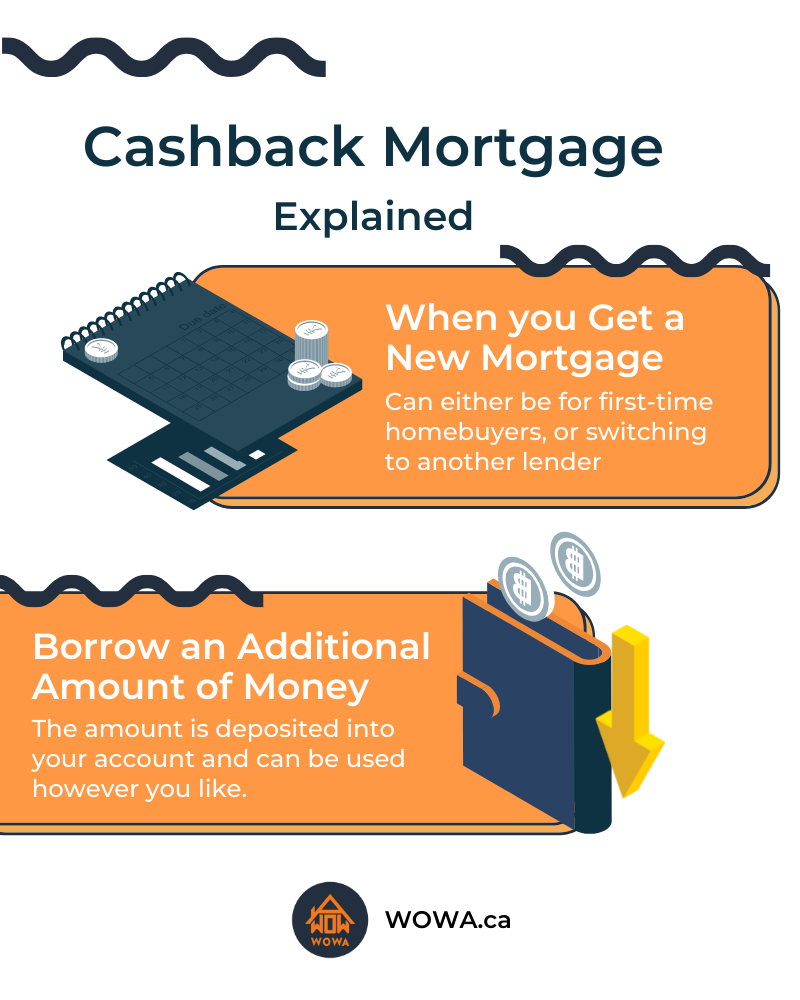
You don't normally repay the cash back separately while making your regular mortgage payments. However, you may also need to repay some or all of the cash back if you break, refinance, transfer, or discharge your mortgage before the end of the term. The amount you need to repay depends on your lender's cash back conditions.
Productive ways to spend your cash back
Now that you understand what a cash back mortgage is, you may want to know why you'd want one. As stated previously, the most common reasons people want a cash back mortgage are to help cover closing costs or to have an emergency fund if there are any issues with their new home. However, some other ways to spend your cash back include:
- Renovate your home
- Pay off high-interest debt
- Invest the money
- Put the money into savings
It is also noteworthy that since you receive the cash back after closing, you cannot use it to make a down payment.
Pros and Cons of Cash Back Mortgage
| Pros | Cons |
|---|---|
|
|
Cash Back Mortgage Alternatives
A cash back mortgage is simply a type of mortgage in Canada. It can be used if you need cash after buying a home or to help cover closing costs, depending on when your lender provides the cash back. There are a few other mortgage alternatives.
| Name | Typical Cost of Borrowing |
|---|---|
| RRSP Home Buyers' Plan | 0% |
| Readvanceable Mortgage | Variable; typically based on the lender's prime rate and often prime + 0.50% to prime + 1.00% |
| Credit Card | Varies; typically 19.99%–24.99% |
| Unsecured Loan | Varies by lender and borrower; often 8.99%–34.99% |
- RRSP Home Buyers' Plan: The Home Buyers' Plan allows eligible homebuyers to withdraw up to $60,000 from their RRSP tax-free to buy or build a qualifying home. The amount generally needs to be repaid to an RRSP over a period of up to 15 years. This can free up other savings for expenses such as closing costs or furniture. We also have a guide on the RRSP Home Buyer's Plan to help you learn more.
- Readvanceable Mortgage: Combines your mortgage with a home equity line of credit. The HELOC allows you to withdraw money whenever you want, and you'll only be charged on the amount you use. You can learn more about this product through our readvanceable mortgage guide.
- Credit Card: This option charges the most interest, as demonstrated by the APR. Credit cards generally provide an interest-free grace period on new purchases if you pay your statement balance in full by the due date. Federally regulated financial institutions must provide a grace period of at least 21 days. However, the grace period does not apply to cash advances, cash-like transactions, or balance transfers. Missing a payment or having too high a balance will affect your credit score. There are also some cash back credit cards that allow you to earn up to 5% back on your spending.
- Unsecured Loan: This type of loan is lent to you by a financial institution without requiring collateral. The APR is lower than a credit card but higher than a mortgage.
The hidden cost of a cash back mortgage
| Cash back mortgage rate | 4.00% |
| Non-cash back interest rate | 3.50% |
| Cash back interest paid | $93,075 |
| Non-cash back interest paid | $81,181 |
| Additional interest paid | $11,894 |
Cash back mortgages usually have a higher interest rate than comparable mortgages without cash back. This higher rate is applied to your entire mortgage balance throughout the term. As a result, the additional interest you pay may exceed the amount of cash back you receive.
As an example, we can calculate the additional cost over a five-year term on a $500,000 mortgage with a 25-year amortization and 1% cash back, based on a cash back mortgage rate of 4% compared to a non-cash back mortgage rate of 3.5%.
As you can see, in exchange for the $5,000 cash back, you pay an additional $11,894 in interest.
Cash Back Mortgage Lenders in Canada
Cash back mortgages are offered by several Canadian lenders. Some lenders provide cash back as a percentage of your mortgage amount, while others offer a fixed amount based on your mortgage size or whether you are buying a home or switching lenders.
Percentage-Based Cash Back Mortgages
These lenders offer dedicated cash back mortgage programs where the cash back is calculated as a percentage of your mortgage amount.
| Lender | Cash Back | Maximum | Expiry |
|---|---|---|---|
| RBC | Up to 7% | $20,000 | No stated expiry |
| Scotiabank | Up to 5% | Not specified | No stated expiry |
| Simplii Financial | Up to 5% | Not specified | No stated expiry |
| RMG Mortgages | Up to 3% | Not specified | No stated expiry |
Note: Offers as of September 2, 2026.

RBC Cash Back Mortgage
The RBC Cash Back Mortgage is available with eligible fixed closed mortgages. RBC offers up to 7% cash back, depending on your mortgage size and term, to a maximum of $20,000. View RBC's Cash Back Mortgage.

Scotiabank Cash Back Mortgage
Scotiabank offers up to 5% cash back on eligible fixed closed mortgages. The amount available varies depending on your mortgage term. View Scotiabank's Cash Back Mortgage.
Fixed-Amount Mortgage Cash Back Offers
Some lenders instead provide a set cash amount based on your mortgage size or transaction type. These offers are often promotional and may change frequently.
| Lender | Cash Back Offer | Expiry |
|---|---|---|
| CIBC | $500–$4,500 for purchases; $1,000–$5,500 for switches | Nov. 1, 2026 |
| TD | Up to $4,000; up to $5,100 when switching | Dec. 29, 2026 |
| BMO | $1,100–$4,100 mortgage cash back | Sep. 4, 2026 |
| National Bank | Up to $3,500 for purchases* | Nov. 3, 2026 |
| Manulife Bank | $1,000 | No stated expiry |
| ATB Financial | $2,000–$6,000 | Oct. 31, 2026 |
Note: Offers as of September 2, 2026.
*National Bank has additional mortgage-related cash back promotions that can be combined in some circumstances; $3,500 is the core purchase mortgage cash-back offer shown here.

CIBC Mortgage Cash Back
CIBC offers promotional cash back on eligible home purchases and mortgage switches. The amount depends mainly on your mortgage size and whether you are purchasing or switching. View CIBC's Mortgage Cash Back Offer.
BMO Mortgage Cash Back
BMO periodically offers cash back on eligible new mortgages and mortgage switches. The amount generally increases with the size of the mortgage. View BMO's Mortgage Offer.
TD Mortgage Cash Back
TD offers cash back on eligible mortgages, with additional cash back available for borrowers switching their mortgage from another lender. View TD's Mortgage Cash Back Offer.

National Bank Mortgage Cash Back
National Bank offers promotional cash back on eligible home purchases, with the amount depending on the mortgage size. Other mortgage-related cash back offers may also be available. View National Bank's Mortgage Offers.
Note: Cash back amounts, eligibility requirements and promotional periods can change. Check with the lender for its current offer before applying.
Is a Cash Back Mortgage Worth It?
A cash back mortgage can be worthwhile if you need cash for expenses after buying a home and expect to keep the mortgage for the full term. However, the higher mortgage rate can result in additional interest costs that exceed the cash back you receive. You should compare the total borrowing cost with a similar mortgage without cash back before choosing an offer.
A cash back mortgage may be less suitable if you expect to sell, refinance or switch lenders before your term ends, since you may have to repay some or all of the cash back in addition to paying a mortgage prepayment penalty.
Disclaimer:
- Any analysis or commentary reflects the opinions of WOWA.ca analysts and should not be considered financial advice. Please consult a licensed professional before making any decisions.
- The calculators and content on this page are for general information only. WOWA® does not guarantee the accuracy and is not responsible for any consequences of using the calculator.
- Financial institutions and brokerages may compensate us for connecting customers to them through payments for advertisements, clicks, and leads.
- Interest rates are sourced from financial institutions' websites or provided to us directly. Real estate data is sourced from the Canadian Real Estate Association (CREA) and regional boards' websites and documents.